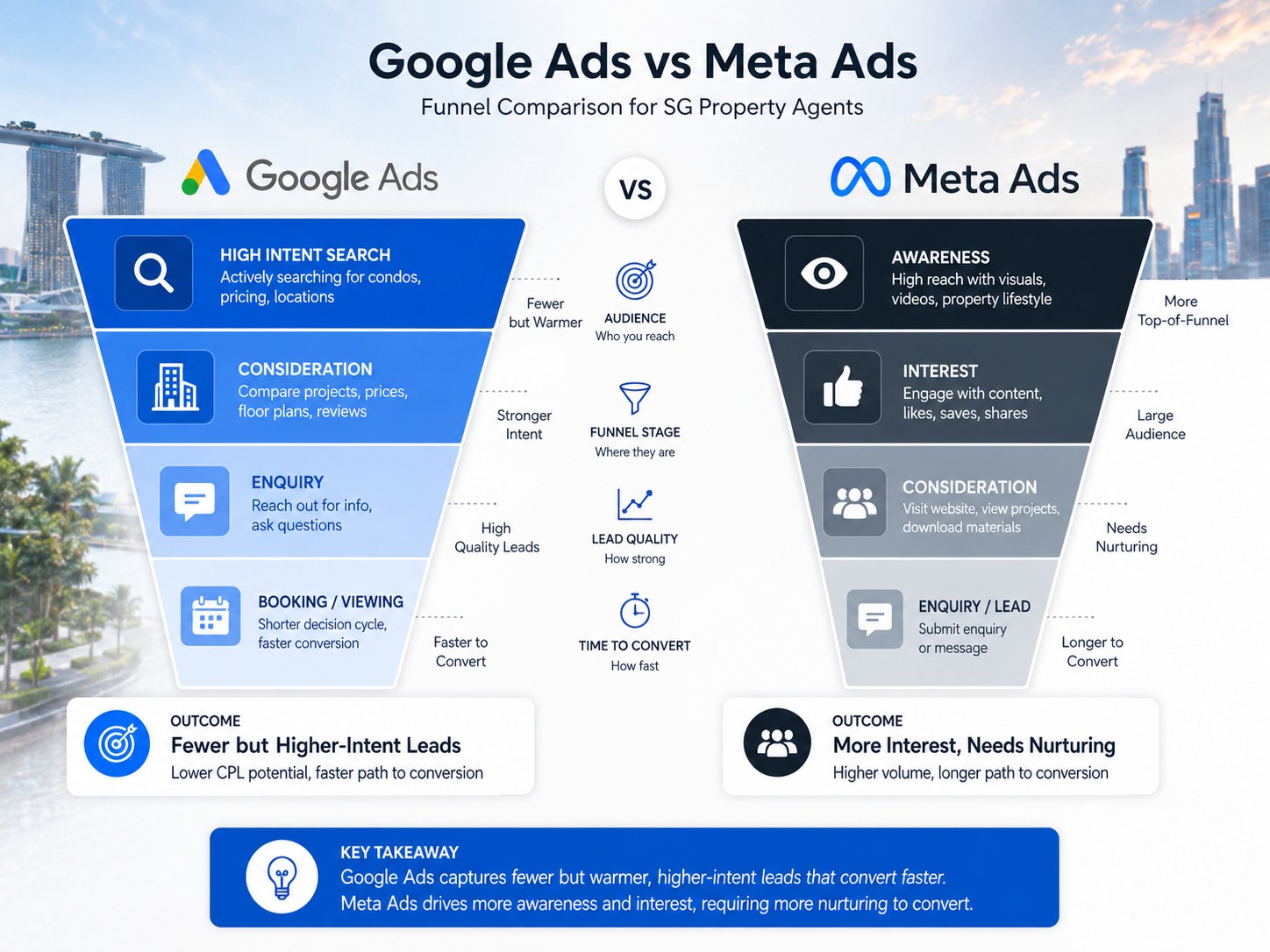
For a Singapore property agent, Google Ads usually wins on lead quality and Meta wins on cost-per-click — but cheap clicks aren't cheap leads. Google captures buyers actively searching ("D10 condo for sale"); Meta interrupts people who weren't looking. For most agents chasing genuine enquiries, Google's higher cost per click buys far higher intent. The right answer for many is "Google first, Meta for retargeting" — and here's exactly why.
Walk into any agent WhatsApp group and you'll find the same argument on loop: "Facebook leads are so cheap!" versus "Facebook leads are all tyre-kickers." Both camps are right — they're just measuring different things. One counts clicks; the other counts closings. Until you separate those two numbers, you'll keep pouring budget into whichever platform feels cheaper this month.
This piece settles it with how the two platforms actually differ for property, what each really costs in Singapore, and a simple rule for splitting your budget.
01 The core difference: intent vs interruption
Google Ads is intent-based. Someone types "freehold condo District 15" into Google because they want one now. Your ad meets a buyer mid-decision. Meta Ads (Facebook and Instagram) is interruption-based: you show a property to someone scrolling for entertainment who wasn't shopping for a home at all. You can target them by demographics and interests, but you're creating demand, not capturing it.
That single distinction explains every downstream difference. Google leads are fewer, pricier and warmer. Meta leads are plentiful, cheaper and colder. Neither is "better" in the abstract — it depends on whether you want volume to nurture or intent to close.
02 What each costs in Singapore (2026)
Real estate keywords in Singapore are competitive. Search cost-per-click for property terms typically runs S$5–12, among the higher brackets in the market because each closed client is worth so much. Meta clicks are far cheaper — often under S$1 — but the conversion gap is the whole story.
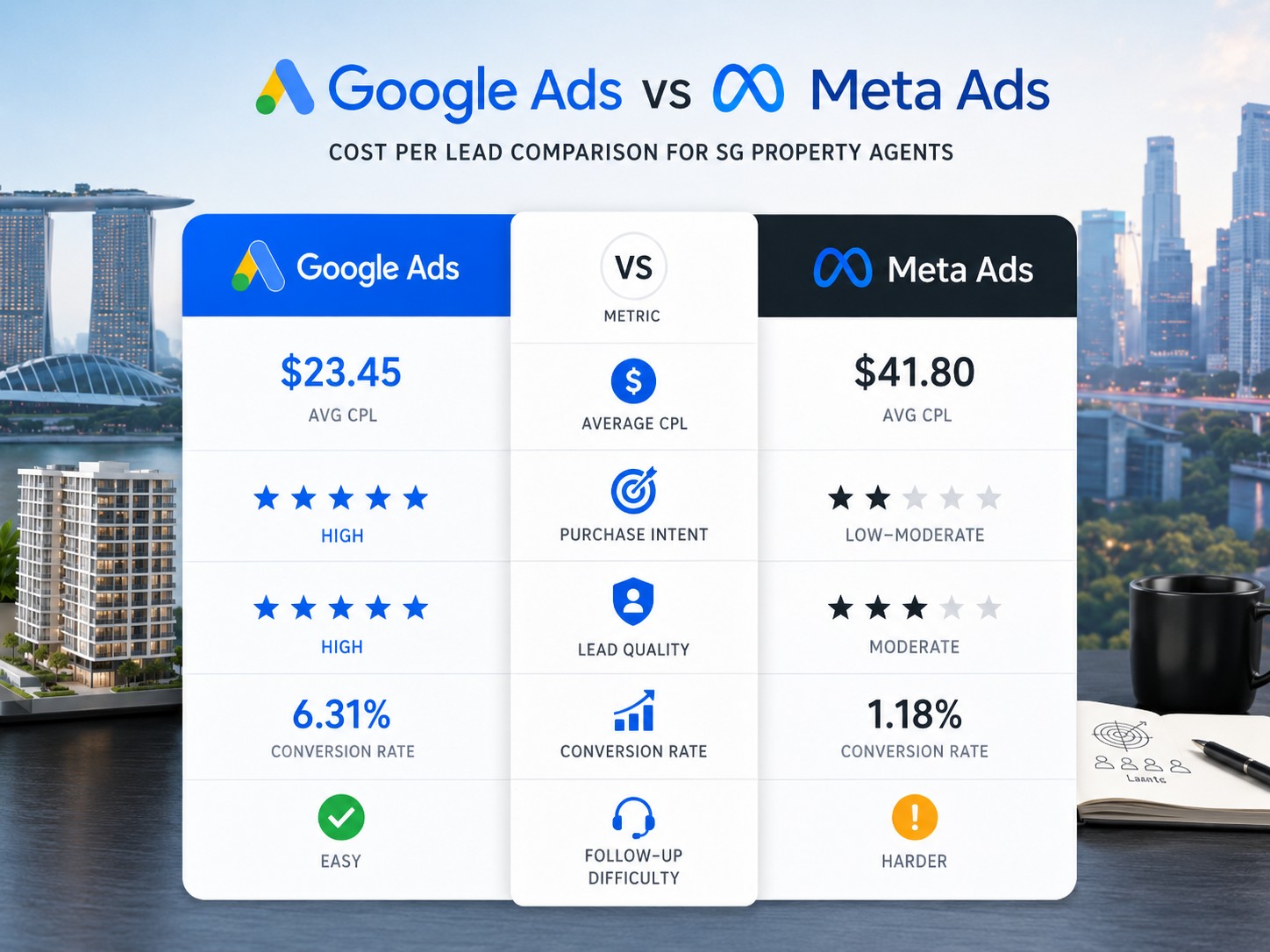
| Metric | Google Search Ads | Meta (FB/IG) Ads |
|---|---|---|
| Typical CPC (SG property) | S$5–12 | S$0.40–1.50 |
| Lead intent | High (actively searching) | Low–medium (interrupted) |
| Search-to-lead conversion | ~3% of clicks | Higher click rate, lower quality |
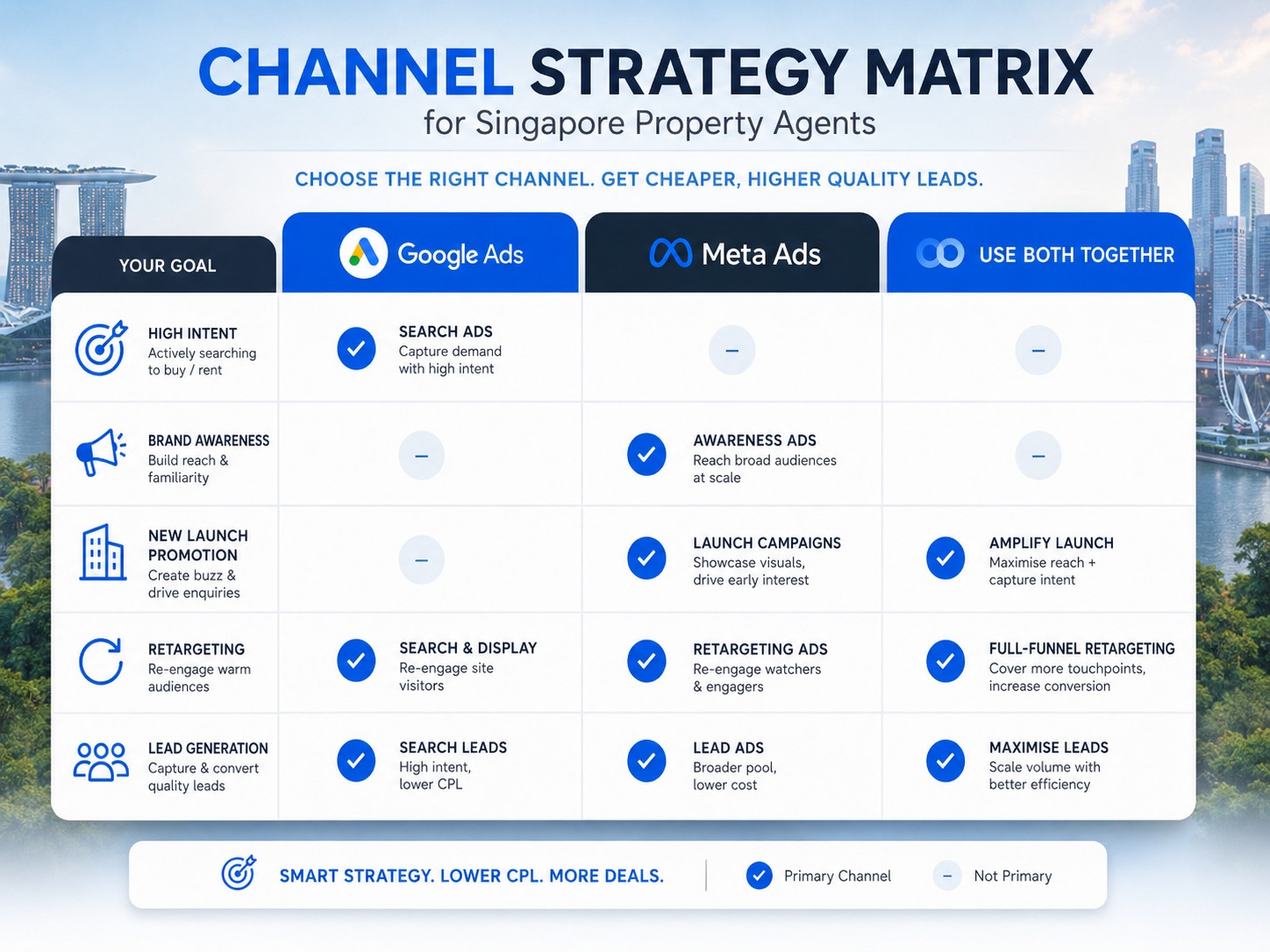
| Best for | Capturing live demand | Awareness, retargeting, new launches |
| Cost per qualified lead | Often lower despite higher CPC | Often higher once you filter junk |
The number that actually matters
Stop comparing cost-per-click. Compare cost per qualified lead — and ideally cost per appointment booked. A S$10 Google click that books a viewing beats fifty S$0.50 Meta clicks that ghost you. Track to the appointment, not the form-fill.
03 Where Meta genuinely shines
Meta isn't the weaker platform — it's the wrong-first platform. It excels at three jobs Google can't do well: new-launch awareness (showing a launch to a lookalike audience before anyone is searching for it), retargeting (chasing people who visited your landing page but didn't enquire), and visual storytelling for a specific project. For these, Meta's cheap reach is a genuine advantage.
The mistake is using Meta as your primary lead-capture engine for buyers who are ready now. That's Google's job.
04 The budget split that works
For most solo agents and small teams, a sensible starting allocation is:
- 60–70% Google Search — capture high-intent buyers searching your district and project keywords.
- 20–30% Meta retargeting — chase the people who clicked your Google ad and landed on your page but didn't convert. This is the highest-ROI Meta spend there is.
- 0–20% Meta prospecting — only for active new-launch campaigns where awareness matters before search demand exists.
This is why the foundation underneath both platforms matters more than the platform choice: every dollar from either channel should land on a dedicated, fast landing page built to convert — not a generic homepage or a portal listing. The most expensive Google Ads mistake is sending paid clicks to a page that was never designed to capture them.
05 A simple decision rule
Ask one question: is the buyer already looking, or do I need to make them look? If they're already searching — resale listings, district demand, "agent near me" — lead with Google. If you're introducing something nobody's searching for yet — a brand-new launch, a niche landed segment — open with Meta for awareness, then retarget the interested ones and let Google catch them when they start searching by name.
The agents who win paid media don't pick a side. They run Google to capture intent, Meta to build and retarget demand, and route both to a page that converts.
Free Google Ads teardown
Send us your current Google or Meta campaign and we'll record a short video pointing out where you're losing money — wrong keywords, weak landing page, untracked conversions — and the three changes that would lift qualified leads first.
Request a free teardown →