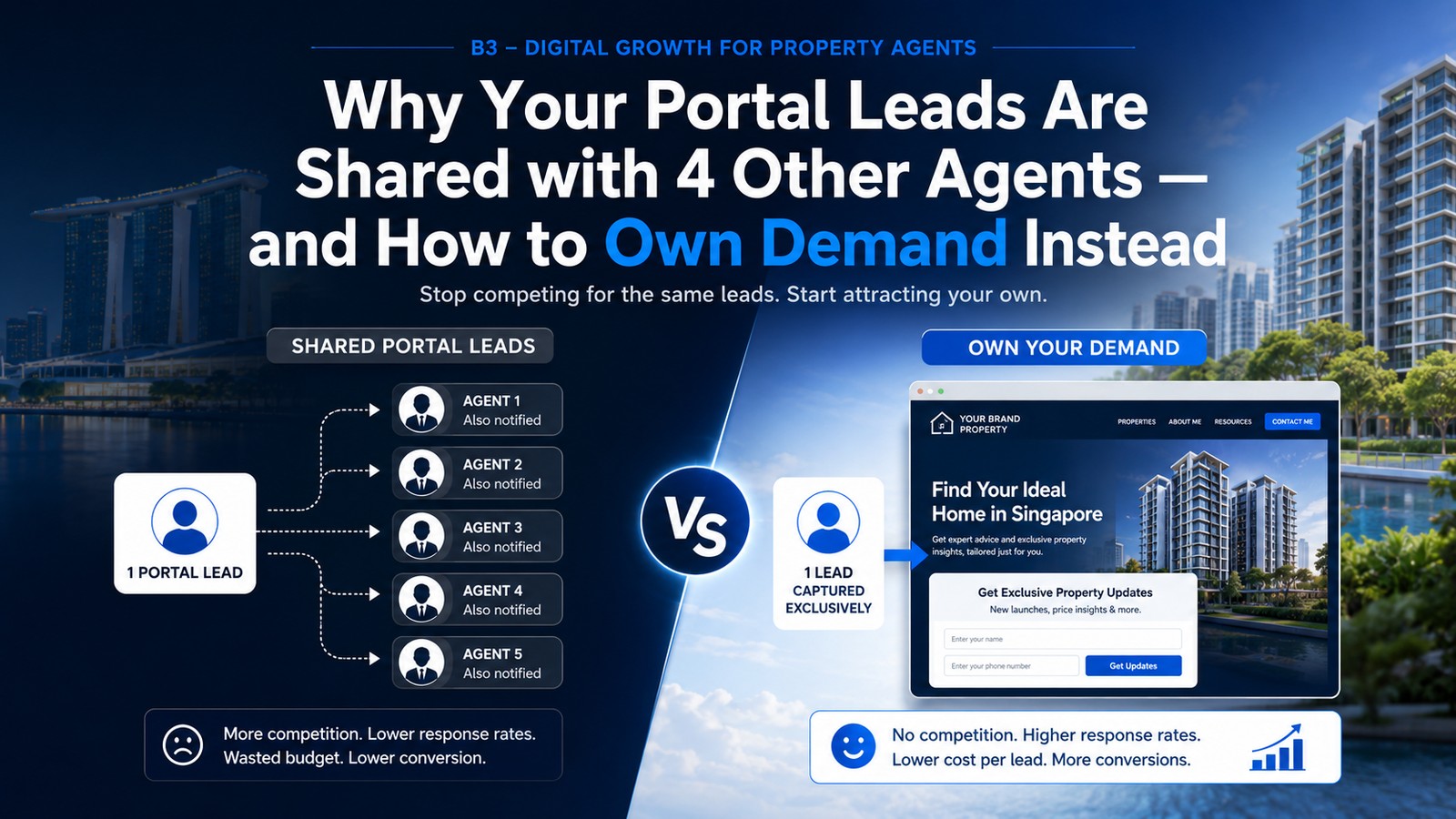
When you pay for a portal lead, you're usually not the only agent who got it. A buyer browsing similar units typically enquires with several agents at once, so the same lead lands in three or four inboxes. You then compete on who replies fastest and quotes lowest — a race that caps your conversion and erodes your margin. The fix isn't a better portal; it's owning the demand so the lead is exclusively yours.
Picture a buyer scrolling PropertyGuru at 11pm. They like four similar two-bedders, and they tap "enquire" on all four — because why not? Within minutes, four agents get the same lead. Three of you will spend time, energy and maybe ad budget chasing a buyer who was always going to pick one. That's not bad luck. That's the business model.
Understanding why this happens — and what it costs you — is the first step to escaping it.
01 Why portal leads get shared
Portals are designed around listings, not relationships. A buyer searches a type of unit, sees many near-identical options, and enquires broadly to compare. The portal's job is to maximise enquiries across its inventory — not to hand any single agent an exclusive lead. So the same buyer naturally reaches several agents, and the platform is paid for each placement regardless of who closes.
The uncomfortable maths
If a lead is shared four ways, your realistic odds of converting it start at roughly one in four — before skill, speed or follow-up. You're paying full price for a quarter-share of a buyer. That's why "cheap" portal leads often have a high true cost per closing.
02 What shared leads actually cost you
The damage isn't only the conversion rate. Shared leads quietly tax you three ways:
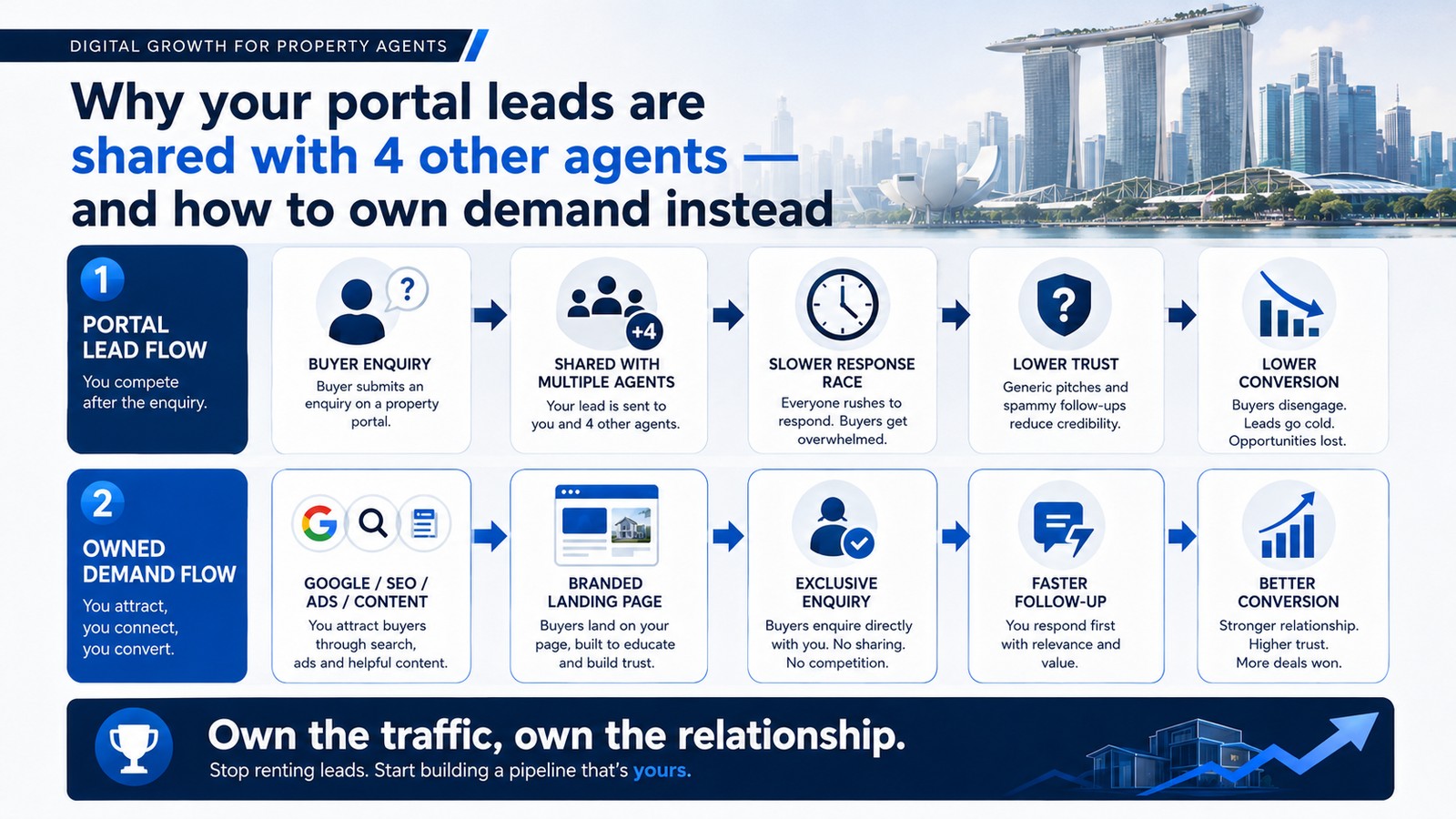
- Wasted time. You respond, qualify and maybe view — for a buyer who picks a competitor. That time has a real cost.
- Price pressure. When a buyer is talking to four agents, the conversation drifts toward commission and concessions. Exclusivity is what lets you compete on value instead.
- No relationship moat. The buyer met you the same moment they met three rivals. You have no head start, no trust advantage — just speed.
03 Why "just reply faster" isn't the answer
The standard advice is to win shared leads on response speed — and yes, replying in the first five minutes matters. But it's a treadmill: every agent is being told the same thing, so speed becomes the baseline, not the edge. You can win a slightly larger slice of a shared pie, or you can stop sharing the pie. The structural fix beats the tactical one.
04 How to own demand instead
An owned channel changes the dynamic completely. When a buyer finds you through your own landing page — from a Google search, a referral, your personal brand — the enquiry is exclusively yours. There's no race, no four-way split, and the buyer arrived in your context, on your terms.
| Shared portal lead | Owned-channel lead | |
|---|---|---|
| Exclusivity | Split 3–4 ways | 100% yours |
| You compete on | Speed and price | Positioning and trust |
| Buyer's first impression | One of four agents | The agent they chose to contact |
| Repeatability | Pay again next month | Asset compounds over time |
05 The shift that pays off
You don't have to abandon portals — they still provide reach. But the agents who escape the shared-lead trap reinvest a portion of portal spend into owned demand: a landing page, Google Ads pointing to it, and a personal brand that makes buyers seek you by name. Those leads arrive exclusive, warmer and cheaper over time.
For the full cost comparison, read PropertyGuru vs landing page; to choose your portals deliberately rather than by habit, see PropertyGuru vs 99.co vs EdgeProp.
Free cost-per-lead breakdown
We'll estimate how many of your portal leads are likely shared, what that's costing you in true cost-per-closing, and how an owned page would change the maths — in a short, no-pressure breakdown.
Request a free breakdown →