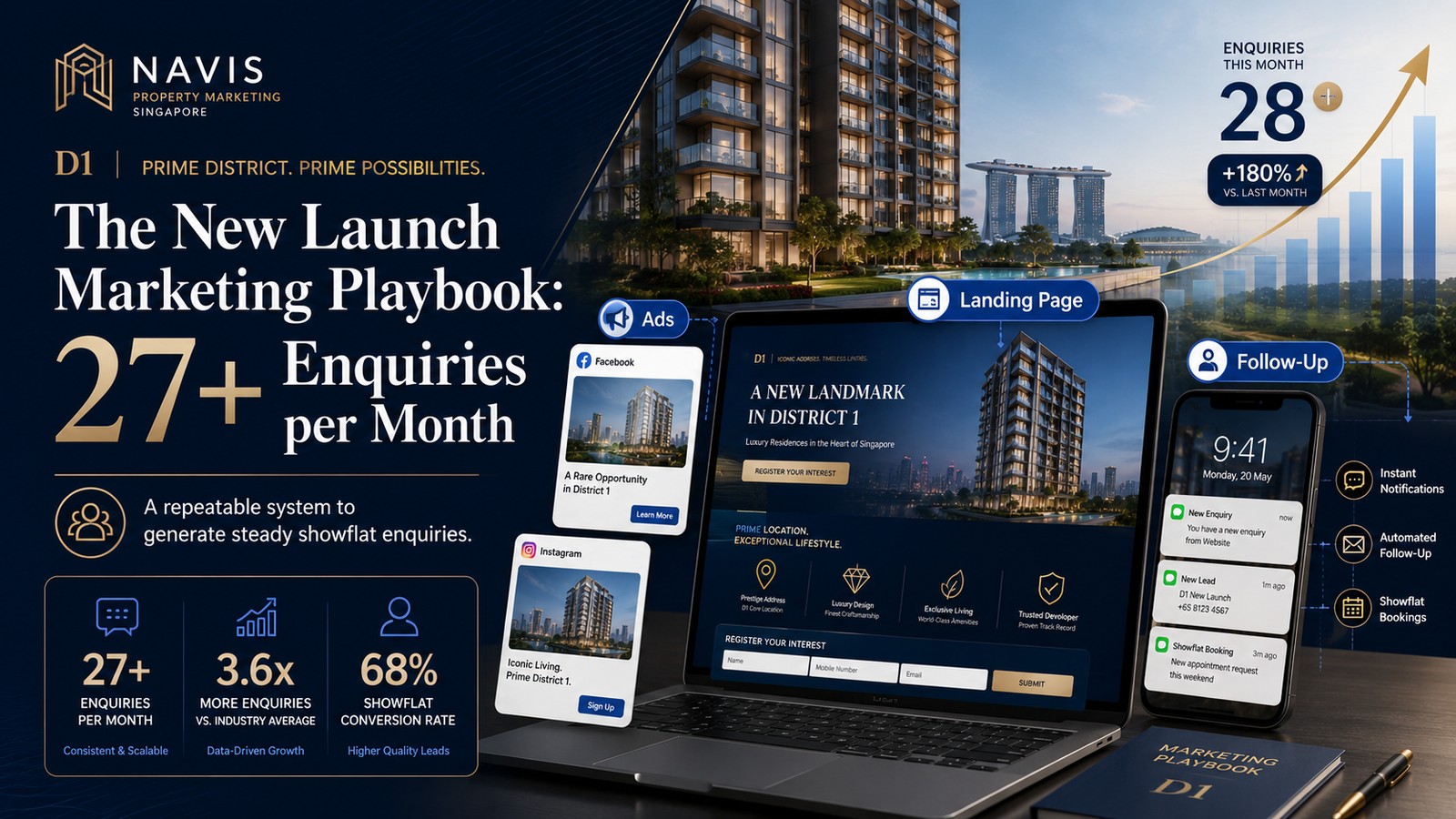
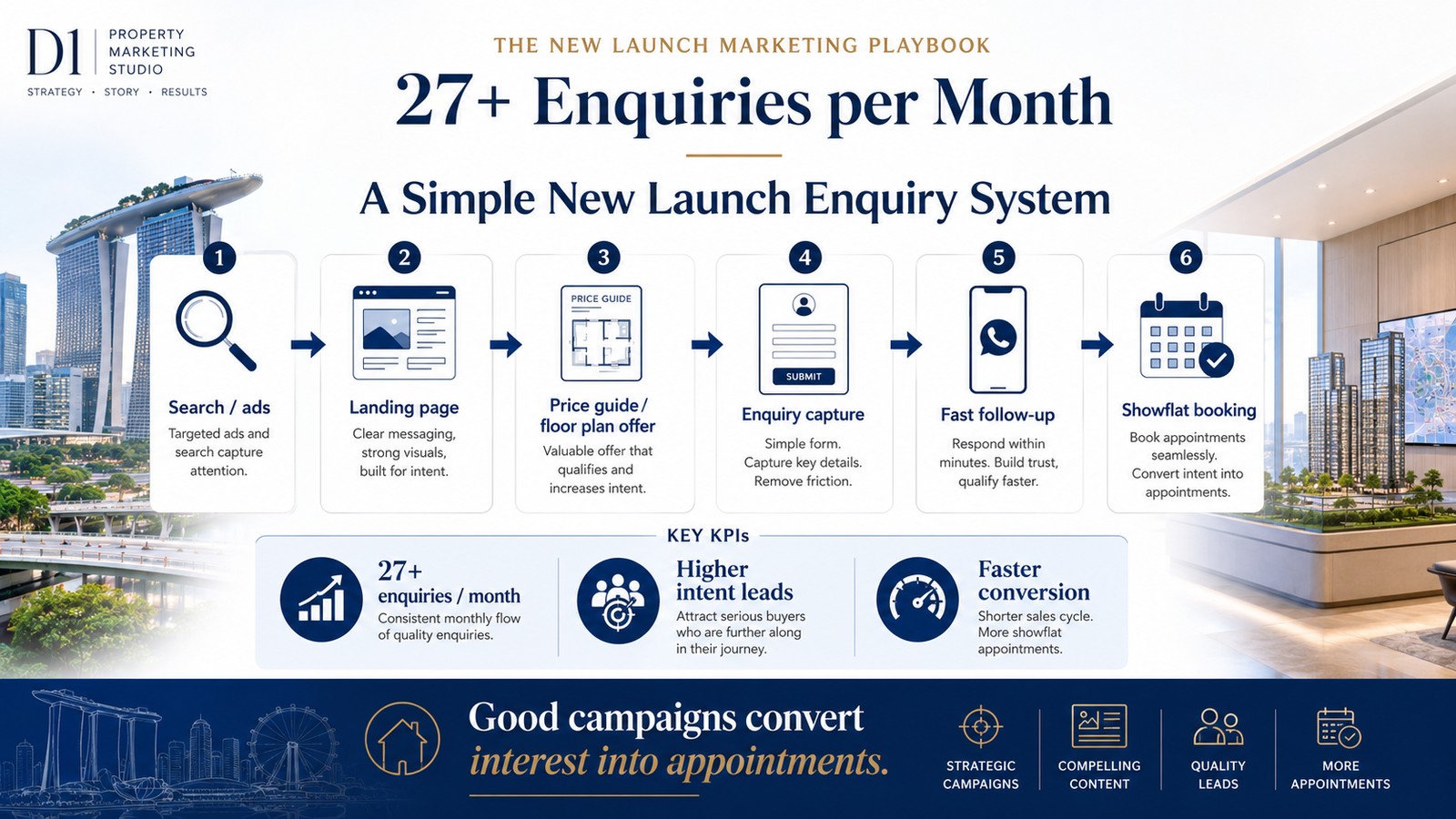
An average Singapore new launch has 40–60 active agents competing for the same buyer pool, all directing traffic to the developer's generic page. Smarlling-built new launch campaigns average 27+ qualified enquiries a month per project by combining a dedicated landing page, three buyer-trigger sections, and a 90-day Google Ads cadence. This playbook walks through every element.
Every new launch in Singapore starts the same way. The developer issues marketing collateral, the agency briefs its teams, fifty agents scramble to print name cards, and within seventy-two hours every agent's WhatsApp DP shows the same project render. By week two, three agents have started running ads on the same five keywords. By week four, the cost-per-click has doubled.
The agents who consistently win on new launches don't outwork that mess. They sidestep it entirely. They build one focused funnel — landing page, ads, follow-up — and let the other forty-nine compete on the developer's page.
01 The new launch problem (in plain numbers)
Most new launch campaigns lose money because the agent is competing on the wrong surface. Here's the typical dynamic in week one of a launch:
| Surface | Agents competing | Avg conversion |
|---|---|---|
| Developer's project page | 40–60 | ~0.4% |
| PropertyGuru Featured | 15–25 | ~1.1% |
| Generic "Singapore condo" Google Ads | 8–14 | ~0.8% |
| Your dedicated landing page | 1 (you) | 4–6% |
A 4–6% conversion rate is not exceptional. It is what happens when the buyer arrives on a page built for one project, with one promise, in one buyer's language — instead of a developer's brochure listing eight floor plans, twelve facilities, and no clear next step.
02 The three buyer triggers (build the page around these)
Every Singapore new launch buyer is, beneath the surface, making one of three decisions. The landing page that converts is the one that answers their trigger first — not the developer's brochure first.
Trigger 1 — Location prestige (D9, D10, D11 buyers)
For prime-district buyers, the project itself is secondary. They are buying postcode. The page must lead with district narrative: surrounding schools, MRT access, the streetscape, the neighbours. Floor plans go below the fold.
Trigger 2 — Tenure preference (Freehold vs 99-year)
For investor-leaning buyers, the freehold-vs-leasehold conversation is the gating filter. A freehold project page that doesn't lead with the freehold tenure in the H1 — and a comparison block within two scrolls — has already lost half its qualified traffic.
Trigger 3 — Lifestyle fit (Family / Investor / Foreigner)
The third trigger is the one most agents skip: matching the page to the buyer persona. A family page leads with primary schools, childcare, park connectors. An investor page leads with rental yield, recent transaction prices, expected TOP. A foreigner page leads with ABSD calculation, eligibility, and remote-viewing options. One project, three landing pages.
The split-traffic test
On one D10 freehold launch in 2025, we ran the same Google Ads campaign against (a) a single landing page and (b) three persona-split landing pages. Persona-split delivered 2.4× the qualified enquiry rate for an extra four days of build time. The math compounds fast.
03 Landing page anatomy that converts
The page structure below is the one we deploy for every Smarlling new launch engagement. It is not the only structure that works — but it is the one we've A/B tested against six alternatives, and it has won every test.
- Hero block. Project name, one-line buyer-trigger headline (not the developer's tagline), district, tenure, indicative price range. WhatsApp CTA visible without scrolling. Hero image is the streetscape, not a 3D render.
- Trust strip. Three short proof points beneath the hero — your track record, the developer's track record, the project's TOP date. Three numbers. No paragraphs.
- Unit mix. Simple grid: 1BR / 2BR / 3BR / 4BR with starting price and SQFT range per type. Tap-to-expand floor plans. Do not list every unit.
- Location appeal. Map graphic with five named anchors (MRT, two schools, one mall, one expressway entry). 90 seconds of reading. Not 900.
- Trust signals. Two short testimonials from past clients relevant to this district — not generic praise.
- FAQ. Eight to twelve questions. Answer eligibility, ABSD, payment schedule, expected TOP, comparable transactions. Each answer ≤80 words.
- Final CTA block. One offer: book a showflat slot, request the floor plan, or WhatsApp for the price guide. Not three offers.
"We rebuilt the page in week two of the launch. Same agent, same project, same ad budget. Enquiries went from nine in the first three weeks to thirty-four in the next four."
— Smarlling client, D15 launch, 202504 The 90-day Google Ads cadence
New launch campaigns have a temporal shape that most evergreen Google Ads playbooks ignore. The campaign needs to behave differently across pre-launch, launch and post-launch phases. Below is the cadence we run for every Smarlling new launch client:
| Phase | Weeks | Campaign goal | Primary keywords |
|---|---|---|---|
| Pre-launch awareness | 1–4 | Build retargeting list | "[district] new launch", "upcoming condos [district]" |
| Launch conversion | 5–8 | Drive showflat bookings | "[project name] price", "[project name] showflat", "[project name] floor plan" |
| Post-launch sales | 9–12 | Close late-stage buyers | "[project name] review", "[project name] vs [competitor]", remarketing |
The single most common error in new launch ads is running the same campaign across all three phases. Pre-launch needs broad keywords and a high-converting opt-in (the price guide PDF). Launch conversion needs exact-match brand keywords and a showflat booking CTA. Post-launch needs comparison keywords and a stronger close — incentive, last-unit messaging, or honest "is this for you" copy.
30-day campaign calendar (week-by-week)
- Week 1: Landing page live. Pre-launch ads start. Retargeting pixel installed. Price guide PDF gated.
- Week 2: Two ad creative variants tested. Negative keyword list expanded daily.
- Week 3: First retargeting audience reaches 1,000 — launch retargeting ads.
- Week 4: Launch event / showflat opens. Switch ad copy to "book showflat slot". Pause pre-launch ads.
- Week 5–6: Conversion phase — Maximize Conversions bidding once 30+ leads logged.
- Week 7–8: Comparison content goes live ("[Project] vs [Comparable]"). New ad group spun up.
- Week 9–12: Post-launch sales push. Remarketing intensifies. Brand keywords protected at higher bid cap.
05 Real numbers from 6 campaigns
The benchmark below averages results across six Smarlling new launch campaigns run in 2024–2025. District mix: 2× D9, 1× D10, 2× D15, 1× D19. Tenure mix: 4 freehold, 2× 99-year.
| Metric | Avg (6 campaigns) | Best |
|---|---|---|
| Ad spend per month | $1,850 | $2,400 |
| Landing page conversion rate | 4.6% | 6.8% |
| Avg enquiries per month | 27 | 41 |
| Effective CPL | $68 | $44 |
| Showflat conversion rate | 22% | 34% |
| Cost per booked viewing | $309 | $129 |
To put the cost-per-booked-viewing number in context: median sale commission on a Singapore new launch in 2025 was approximately $18,000–$34,000. A $309 cost-per-viewing, even at a 1-in-8 close rate, returns the spend in the first conversion.
Free new launch campaign audit
Send us your current new launch landing page (or developer URL) and your Google Ads account. We'll send back a 15-minute Loom showing exactly where your current funnel is losing buyers — landing page, ad copy, keyword structure, and follow-up flow. Delivered in 48 hours.
Request a free audit →