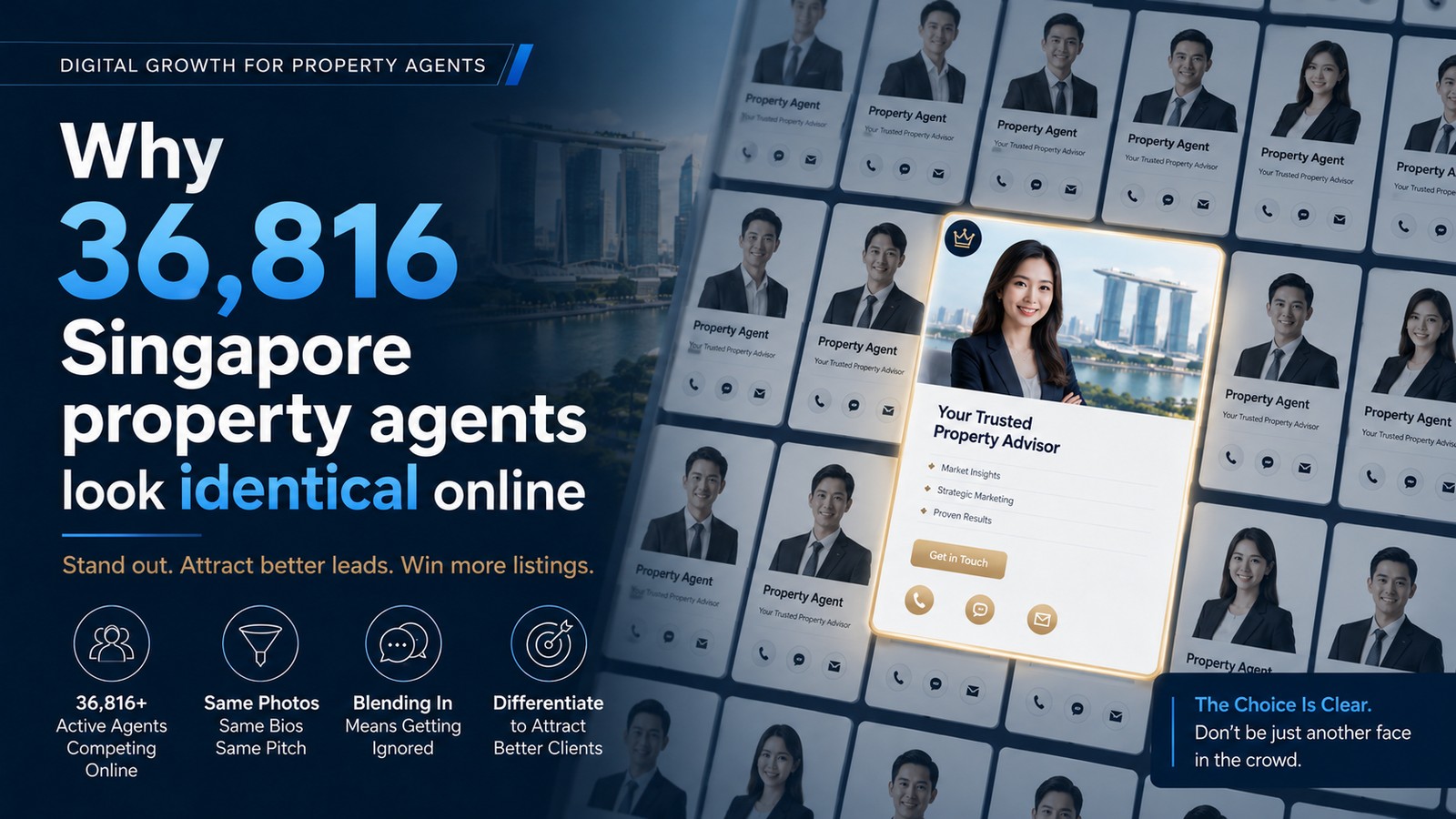
As of late 2025, the CEA register lists 36,816 active property agents across 997 agencies in Singapore — the highest agent-per-agency ratio in over a decade. The supply of agents has outpaced both transaction volume and audience attention. Visibility alone no longer differentiates anyone. The agents winning in 2026 are running disciplined personal-brand positioning, not louder listings.
Open a Singapore property portal. Scroll through twenty agent profiles. Headshot. Smile. Awards row. "Trusted property advisor." "I help you find your dream home." Same hero image of Marina Bay. Same WhatsApp button.
If you've been in the industry more than five years, you've watched this homogenisation happen in real time. The good news is the fix isn't more posting. It's positioning — and it can be installed in 30 days.
01 The 36,816 problem
The numbers are publicly available and they tell a clean story. The Council for Estate Agencies (CEA) Public Register shows the agent count climbing every year while the agency count contracts. The ratio sits near 37 agents per agency — the highest in over ten years.
| Year | Registered agents | Active agencies | Ratio |
|---|---|---|---|
| 2015 | ~30,800 | 1,287 | 23.9 |
| 2019 | ~28,400 | 1,124 | 25.3 |
| 2022 | ~32,000 | 1,058 | 30.2 |
| 2025 | 36,816 | 997 | 36.9 |
What this means in practice: when a buyer searches for "D9 property agent" or "HDB upgrader specialist", the search engine is choosing between dozens of agents who, on paper, look interchangeable. The strategy that worked in 2018 — list harder, post more, run more boost ads — is now the same strategy 36,815 other agents are running.
"I've been in this 8 years. I've closed 50+ deals. My PropertyGuru profile looks identical to a junior who passed CEA last month. Same layout, same smile, same trust signals. The format flattens us."
— SG senior agent, D10 specialist02 The 5 generic templates most SG agents fall into
From auditing ~120 agent profiles and sites this year, almost every agent online maps to one of five archetypes. Read these and be honest about which one is currently you:
- The Listing Bot. Profile is 100% listings, no story. The agent is invisible behind the inventory. Buyers form no emotional preference — they'll pick whoever has the unit they want.
- The Family Photo Agent. Smiling photo with family, "trusted advisor" copy, generic trust signals. Warm but undifferentiated. Looks like every wedding photographer's website.
- The Award Wall Agent. Trophies, top-producer ribbons, screenshots of awards. Authority is implied but never explained. Buyers can't connect a Top 1% badge to a specific buyer outcome.
- The TikTok Performer. Entertaining videos but no positioning. Followers grow, deals don't. Buyers enjoy the content but trust it for entertainment, not transactions.
- The Ghost Agent. No site. No active social. Two-line PropertyGuru bio. Often actually a high performer offline, but invisible to anyone who hasn't been referred.
Self-audit
Open your PropertyGuru profile and your Instagram side by side. If a stranger landed on both with no context, what would they say you specialise in? If the answer is "selling property in Singapore," you're in the 36,815.
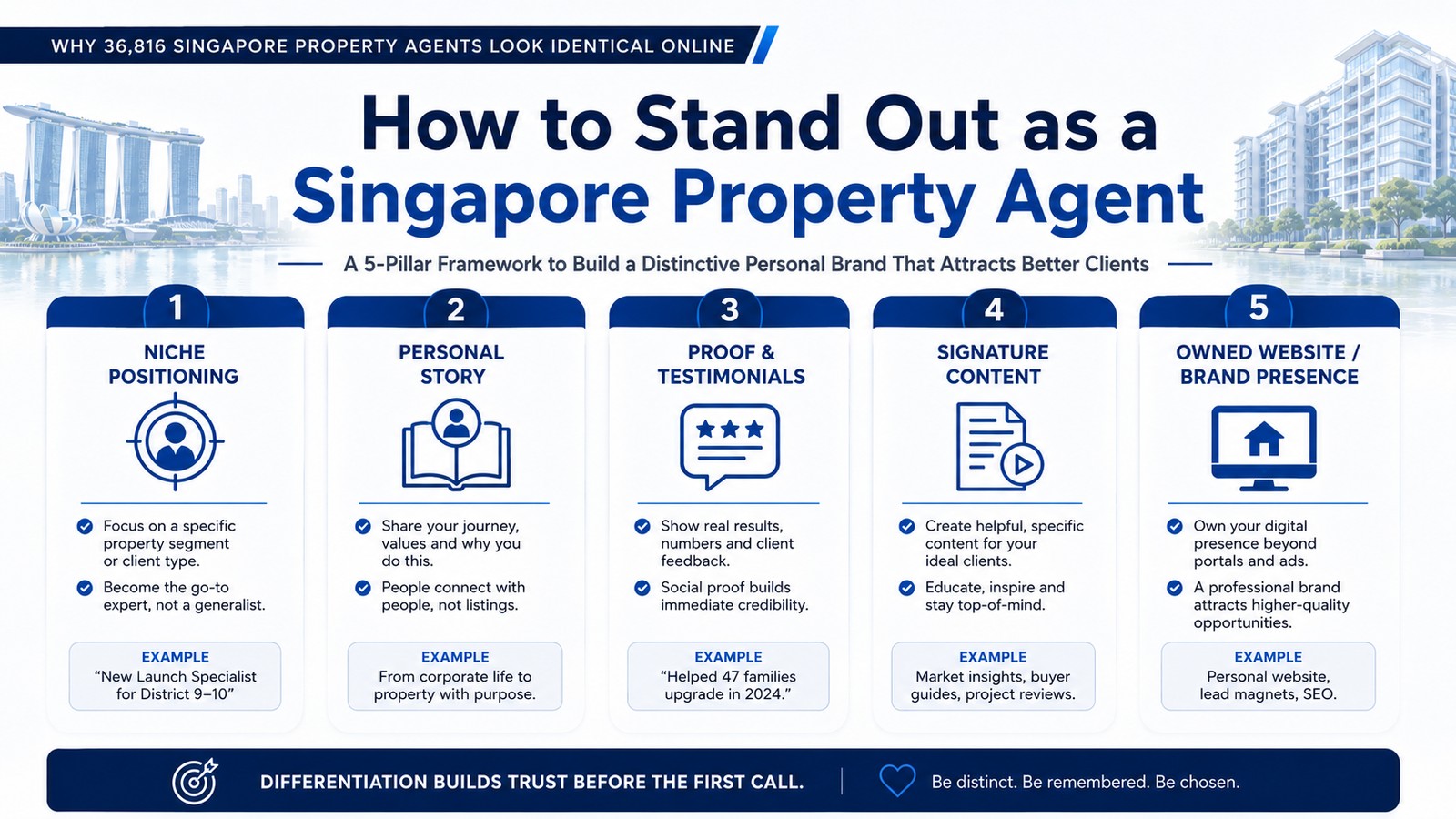
03 What actually works: 3 positioning frameworks
The agents we see winning in 2026 are choosing a clear positioning lane and committing to it for at least 18 months. There are three frameworks that compound:
Framework 1 — District Specialist
You go narrow on geography. "The D9–D11 freehold specialist." Your content, listings, case studies and SEO all reinforce a specific cluster of districts. When a buyer Googles "D10 property agent", you're the obvious answer because you've published the most useful D10 content.
Framework 2 — Buyer Persona Specialist
You go narrow on who you serve. "Foreign-investor specialist." "HDB upgrader specialist." "PR family relocation specialist." The buyer self-identifies in your headline and the trust-build is half done before the first call.
Framework 3 — Transaction-Type Specialist
You go narrow on transaction shape. "New launch only." "Sub-sale and resale only." "Luxury condo above $5M only." You sacrifice breadth for repeatable expertise and higher per-deal margin.
Pick one. Not two, not three. The thing that scares senior agents about narrowing — "I'll lose deals from outside my niche" — is almost always wrong. You don't lose those deals; you just stop showing up for them in search. The deals that come through your niche are far easier to close and worth more per case.
04 The 30-day personal brand sprint
This is the four-week sequence we run with senior agents who want a defensible owned-media presence by end of month one.
| Week | Focus | Deliverable |
|---|---|---|
| Week 1 | Position | One-line positioning statement. One niche. Three "I help X do Y" outcomes. |
| Week 2 | Build | Owned page live: hero, story, niche-specific case studies, CTA. |
| Week 3 | Content | 12 niche-specific posts (LinkedIn / IG / blog). Each one answers a question the niche buyer is already asking. |
| Week 4 | Proof | 5 client video testimonials shot. SEO on page. Tracking installed. |
Day 30 is not "fully optimised." Day 30 is "the asset exists, the message is sharp, and the next 60 days of content publishing has a structure to follow." The compounding starts in months two and three.
05 Senior agent vs TikTok agent: who actually wins in 2026?
Every senior agent we work with asks the same anxious question some version of: "My junior is on TikTok with 80K followers. Am I dead?"
The honest answer: no, but you have to choose your weapon. Entertainment-led TikTok growth is real and it produces deals, but those deals tend to skew toward first-time buyers, lower price points, and high churn. Authority-led personal brand — the long-form site, the niche-specific case studies, the Google search rank — produces fewer but higher-value relationships.
Authority compounds. Dance trends don't. A District-9 luxury seller is not making the decision on a 15-second video. They're checking the third Google result and reading every case study you've published.
Property Agent Positioning Quiz
Ten questions. Five minutes. We score you against the five generic templates and recommend one of the three frameworks. Useful even if you don't work with us.
Take the quiz →