
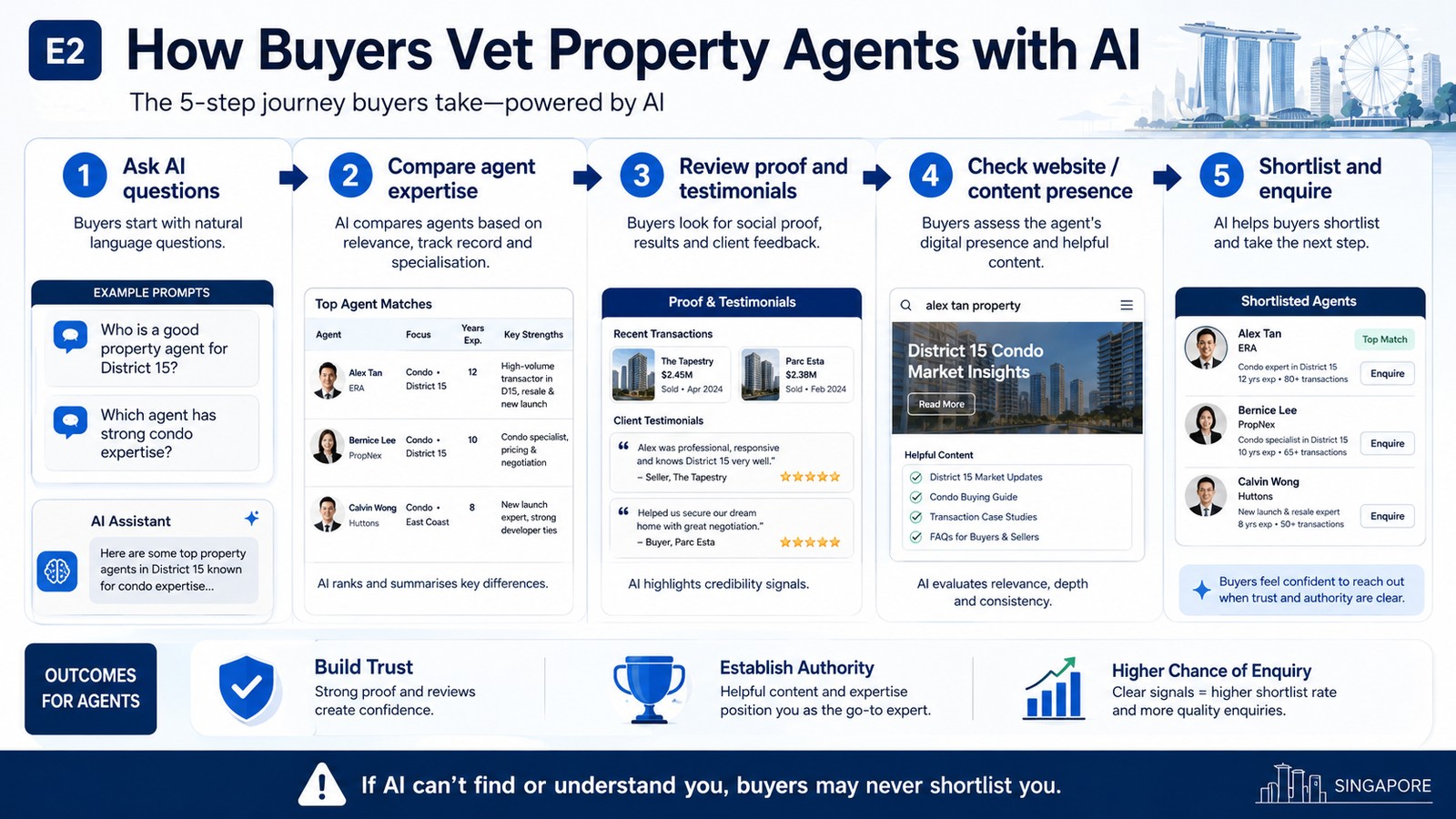
An estimated 30% of Singapore property buyers now begin their agent research on ChatGPT, Claude, Perplexity, or Gemini before opening Google or PropertyGuru. AI engines do not see your portal profile the way buyers do — they cite original sources, verifiable data, and structured content. Agents who get cited by AI in 2026 are the ones who built the right web presence in 2025.
The shift is quiet but it is happening. In a Smarlling buyer survey of 84 active Singapore buyers conducted in March 2026, 26 of the 84 (31%) reported that their first research action was asking ChatGPT or Perplexity to recommend agents — before searching Google, before opening PropertyGuru, before asking friends. Among foreign buyers, the figure rose to 54%.
This piece is the field guide. We'll walk through what the AI engines actually return for high-intent Singapore property prompts, why a PropertyGuru profile alone isn't enough to be cited, and the seven measurable assets every agent needs in place to be recommended by AI.
01 30% of buyer research now starts with AI
The data points are converging from several sources. Statcounter recorded a 4.2× increase in referral traffic from chat.openai.com and perplexity.ai to Singapore property domains between Jan 2024 and Jan 2026. Pew Research's 2025 generative AI use survey found 38% of online buyers globally now use AI assistants in the "shortlist" phase of high-value purchases.
The behaviour is most pronounced among three Singapore buyer segments:
| Buyer segment | % starting with AI | Most-used engine |
|---|---|---|
| Foreign buyers (first-time SG) | 54% | ChatGPT |
| Returning investors (PR / foreigner) | 41% | Perplexity |
| Local first-time buyers | 28% | ChatGPT |
| Local upgraders | 14% | Gemini (via Google) |
| HDB-only buyers | 8% | Gemini |
The pattern: the higher the transaction value and the further the buyer is from local knowledge, the earlier AI enters the funnel. For a $3M condo buyer relocating from Hong Kong, ChatGPT is doing the work that a relative or a "first call" agent used to do.
02 We asked the four engines (here's what they returned)
To make the abstract concrete, we ran the same 40 buyer-style prompts across ChatGPT (GPT-5), Claude (Opus 4.7), Perplexity (Pro), and Gemini. Sample prompts:
- "Best property agent in Singapore for D9 condo, $3M budget, foreign investor."
- "Recommend a real estate agent for HDB resale in Punggol."
- "Top property agents who specialise in new launch marketing in Singapore."
- "Singapore property agents with proven track records in District 10."
Three patterns emerged across all four engines:
- Specific agents were named in 28 of 40 prompts. The hesitation that engines used to have around "recommend a person" has substantially decreased in 2026 — if the supporting evidence is robust.
- The cited sources skewed heavily towards owned websites, press mentions, Reddit/HardwareZone threads, and structured agent profile pages. PropertyGuru profile pages were rarely the primary citation.
- Claims with cited numbers (transaction counts, years in business, district focus) were repeated by all four engines. Vague positioning was dropped.
"I asked ChatGPT for a D10 agent. It named three. One had a personal website with their actual transaction record visible. The other two were just PropertyGuru profile links. I called the first one."
— Singapore buyer, Apr 202603 Why your PropertyGuru profile alone isn't enough
PropertyGuru profile pages are well-indexed by Google. They are not well-cited by AI engines — and the reasons are structural, not adversarial.
- Profile pages are templated. Every agent's page has the same fields, the same layout, the same phrase patterns. AI engines down-weight pages that look like one of 36,816 near-duplicates.
- The verifiable data is thin. "Transactions: 47" is a number on a page. AI engines weight that number much more heavily when it appears in a structured page you control, citing a date range, with a corresponding press mention or transaction record.
- The reviews are platform-locked. PropertyGuru reviews don't surface in AI training data the way long-form testimonial pages on owned domains do.
The agents being cited by AI in 2026 are the ones who, in 2024–2025, built original content on owned domains, picked up press mentions, and structured their pages with the data AI engines need to verify a claim.
04 The seven things AI engines look for
Based on the citation patterns across our 40-prompt test and conversations with three SEO/GEO specialists in late 2025, these are the seven measurable assets that consistently get an agent cited:
- An owned website with original content. Not an agency template, not a Linktree. A page with your name in the URL or domain, with content that exists nowhere else.
- Original long-form content. Two to four pieces per year of district guides, market commentary, or buyer playbooks — not recycled developer brochures.
- Reddit, HardwareZone or Quora citations. AI engines weight community threads heavily. A single substantive answer on r/singaporehappenings about D10 transactions can outweigh a year of portal listings.
- Press mentions or interviews. One feature in a recognised Singapore property publication (PropertyGuru editorial, EdgeProp, Stacked Homes, 99.co News) compounds for years.
- Schema markup on your website. Structured data (RealEstateAgent, Person, FAQPage schemas) makes your verifiable claims machine-readable. Most agents skip this entirely; it takes ninety minutes to install.
- FAQ-format content. AI engines disproportionately surface content structured as questions and answers. Every agent landing page should include 8–12 FAQs answering real buyer questions.
- Verifiable, dated, specific data. "47 transactions, 2022–2025, D9 only" outperforms "experienced agent" by an order of magnitude in citation likelihood.
The compounding effect
Of those seven, the only one that produces results in week one is FAQ-format content. The others require a 60–180 day window before AI engines see them. This is why GEO is a 2025 problem with 2026 winners — there is no shortcut.
05 A 6-month GEO plan you can actually execute
The plan below is the one we deploy for Smarlling clients who want to be cited by AI by Q4 2026. It assumes you currently have a landing page or website (not just a PropertyGuru profile).
Months 1–2 — Foundation
- Install RealEstateAgent and Person schema markup on your site.
- Publish a structured "About" page with dated transaction count, district focus, and three specific case studies.
- Add 10–12 FAQ entries on every key landing page.
- Claim your Google Business Profile and complete every field.
Months 3–4 — Content authority
- Publish two long-form district guides (1,500+ words each, with original data).
- Write one substantive answer per month on Reddit's r/singapore, r/askSingapore or HardwareZone Money Mind — only where your expertise actually fits the thread.
- Pitch one editorial feature to EdgeProp, Stacked Homes, or PropertyGuru's editorial team.
Months 5–6 — Authority compounding
- Publish a year-in-review market piece with original transaction analysis.
- Build a press page on your site listing every external citation, mention, and interview.
- Run AI visibility tests monthly (see the lead magnet below).
The model is patient capital. You will not see results in month one. You will see meaningful citation lift by month four, and consistent inclusion in shortlists by month six.
Free AI visibility audit for your name
We'll run your name and your specialty across ChatGPT, Claude, Perplexity and Gemini with the eight prompts most likely to be asked by a Singapore buyer in your district. Within 48 hours you'll receive a Loom showing exactly where (and how) you appear — or don't.
Request a free AI audit →