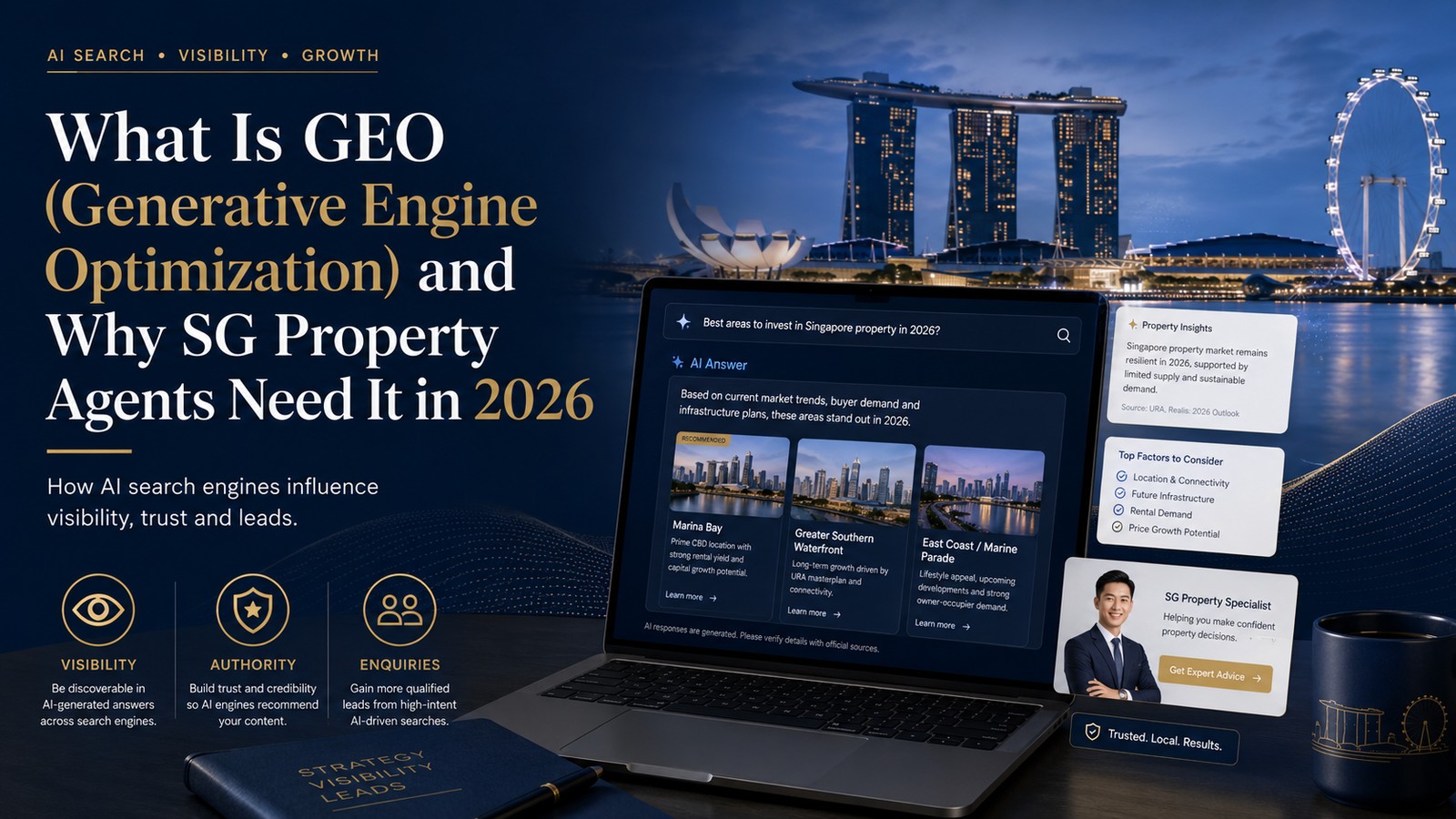
GEO — Generative Engine Optimisation — is the practice of structuring your web presence so AI engines like ChatGPT, Gemini and Perplexity name you when a buyer asks them for an agent. It matters in Singapore more than almost anywhere: 53% of Singaporeans already use AI tools, one of the highest adoption rates on earth. If a buyer asks ChatGPT "who's the best D10 condo agent?" today, an answer already exists — and right now it almost certainly isn't you.
Here is the uncomfortable question every Singapore agent should ask in 2026: when a buyer types your specialty into ChatGPT, does your name come back — or a competitor's? Most agents have never checked. The ones who have are quietly building a moat the other 37,000 can't see.
This is the pillar guide to GEO for property agents. We'll define exactly what it is, show why Singapore is ground zero for this shift, separate it from SEO, and lay out the five things generative engines actually reward. By the end you'll know whether you're invisible to AI — and what closes the gap.
01 What GEO actually is
SEO got you ranked on a page of blue links. GEO gets you named inside an answer. The difference matters because of how people now research. Instead of scanning ten results, a buyer asks one question and reads one synthesised reply — often without ever clicking through.
Generative engines build that reply from two things: what they absorbed during training, and what they retrieve live from the web at the moment of the question. To be in the answer, your name and your facts need to appear in the sources those engines trust — and they need to be structured so a machine can read them without guessing. GEO is the discipline of engineering exactly that.
The mental model
Think of each AI engine as a hyper-efficient buyer's assistant that has already read everything written about Singapore property — and only repeats claims it can verify. GEO is making sure the verifiable claims point to you.
02 Why this is a Singapore problem right now
Three numbers explain the urgency. First, adoption: Singapore's AI usage rate sits at roughly 53% — behind only India and the UAE globally, and well ahead of most Western markets. The buyers asking AI for agents aren't a fringe; they're the mainstream, and they skew toward the high-value foreign and investor segments agents most want.

Second, the trajectory. AI-referral traffic to websites grew more than 500% year-on-year through 2025, while ChatGPT alone reached around 900 million weekly users by early 2026 — more than double the year before. This is not a plateau; it's an early curve.
Third — and this is the one that should make you sit up — quality. Independent analyses of millions of website visits found that traffic arriving from AI engines converts at about 14%, versus roughly 2.8% for ordinary Google clicks. AI users research before they arrive, so they land already half-decided. A single AI citation can be worth more than a month of cold portal leads.
| Where buyers research | Typical intent | What wins you the buyer |
|---|---|---|
| PropertyGuru / 99.co listing | Browsing units | Price & photos (you compete on the unit, not on you) |
| Google search | Looking for options | Ranking + a credible page to land on |
| ChatGPT / Perplexity | Asking "who should I trust?" | Being cited by name with verifiable proof |
03 GEO vs SEO — overlapping, not competing
GEO is not a replacement for SEO; it's the next layer on top of it. The structural work that wins Google — a fast, owned website, clean headings, schema markup — is exactly the foundation generative engines read from. If you've done SEO properly, you're already most of the way to GEO. The gap is in emphasis.
| Factor | SEO weights | GEO weights |
|---|---|---|
| Goal | Rank on the results page | Be named inside the answer |
| Keywords | High importance | Lower — engines read meaning, not exact phrases |
| Structured data | Helpful | Critical — it's how a machine confirms your facts |
| Third-party mentions | Useful backlinks | Decisive — citations build the trust to repeat your name |
| Specific, dated data | Nice to have | Essential — "47 D9 deals, 2022–25" beats "experienced" |
04 The five things generative engines reward
Across ChatGPT, Gemini and Perplexity the signals converge on five themes. Win these and you become a citable source rather than a name the engine has never heard.
- Verifiable, specific, dated data. Numbers an engine can cite without risk. "Closed 47 transactions in D9–D11 between 2022 and 2025" is repeatable; "top agent" is not.
- Machine-readable structure. Schema markup, FAQ-formatted content, and clean headings let an engine extract your facts cleanly instead of guessing. Most agents have none of this — which is the opportunity.
- Third-party citations. A substantive Reddit answer, a Stacked Homes or EdgeProp mention, an interview — engines weight what others say about you far above what you say about yourself.
- Entity consistency. Identical name, photo, contact and specialty across your site, Google Business Profile, LinkedIn and the CEA register. Inconsistency makes an engine unsure you're one person — so it stays silent.
- Freshness. Content that is dated, current, and regularly updated. A 2026 market piece outranks an undated page from years ago in an engine that prizes recency.
05 Why waiting compounds against you
GEO is patient capital. Schema and FAQ content can move citations within weeks, but the heavy signals — press, community mentions, accumulated original data — take 60 to 180 days to mature. That lag is precisely why this is a 2025–2026 decision with multi-year consequences: engines weight historical reliability, so the agent who establishes citation authority first keeps compounding while latecomers start from zero.
The window is open, not closed
Fewer than one in twenty Singapore agents has done any deliberate GEO work. That's the gift: the bar to becoming "the agent AI recommends" in your district is still low. It will not stay that way once the field catches on — and Perplexity has already begun testing sponsored placements.
Start with the two guides that turn this strategy into action: how to actually get cited by ChatGPT, Gemini and Perplexity, and the schema markup every agent needs installed. For the demand side — proof that buyers are already doing this — see how Singapore buyers use ChatGPT and Perplexity to vet agents.
Free AI visibility audit for your name
We'll run your name and specialty across ChatGPT, Gemini and Perplexity using the eight prompts a Singapore buyer in your district is most likely to ask. Within 48 hours you'll get a short video showing exactly where you appear — or where a competitor does instead.
Request a free AI audit →