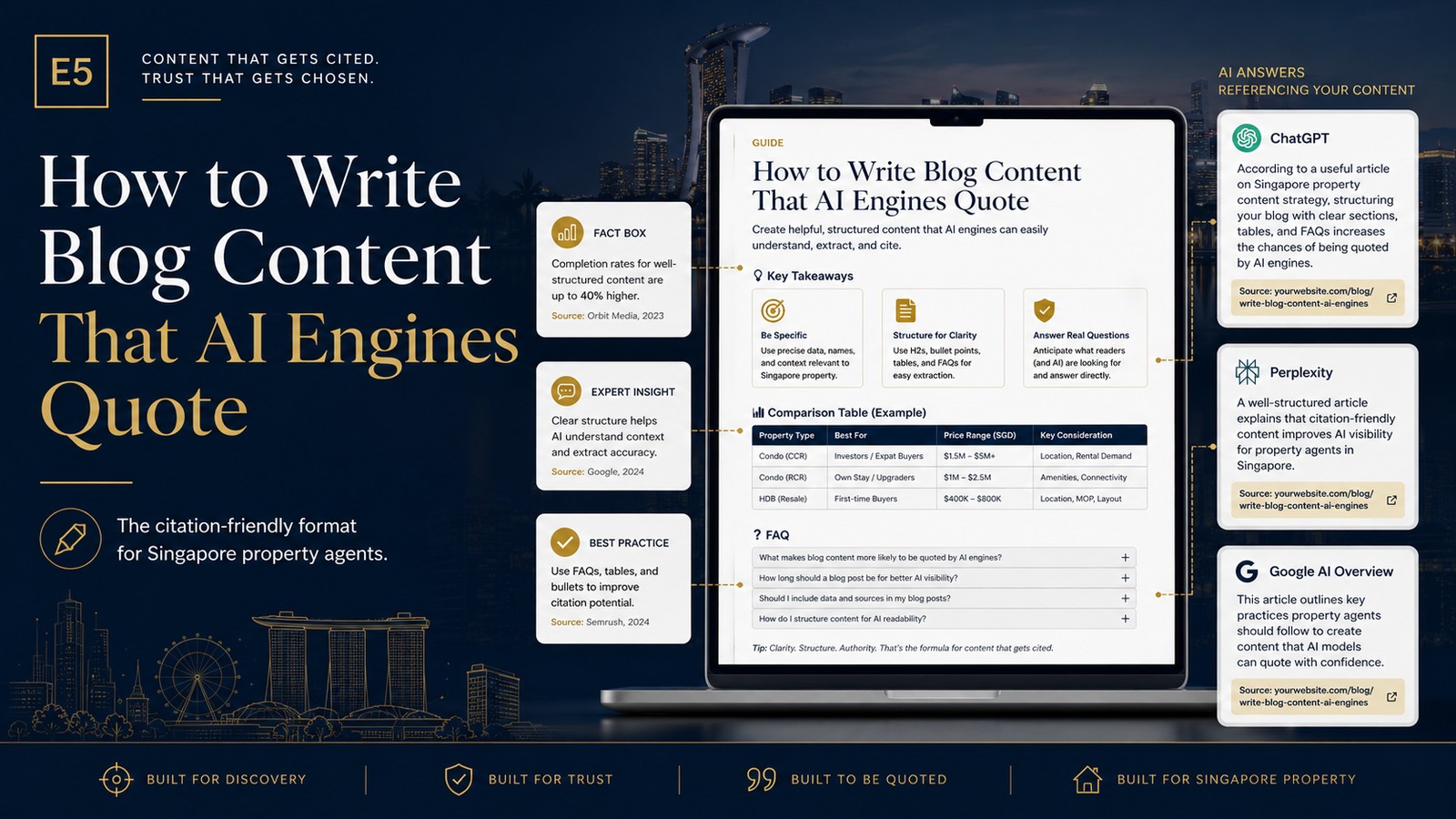
AI engines don't quote your most eloquent paragraph — they quote your most extractable one. A clear, dated, self-contained sentence gets lifted straight into a ChatGPT answer; a beautiful but vague one gets ignored. Six rules separate content that gets cited from content that gets scrolled past. None of them require you to write more — just to write differently.
Two agents write about District 10. One produces a flowing, lyrical piece about "the timeless prestige of prime district living." The other writes: "D10 freehold condos averaged S$2,950 psf in Q1 2026, up 4% year-on-year." Guess which sentence ends up inside a ChatGPT answer — verbatim, with a citation back to its author. Eloquence loses to extractability every time.
This is the format that gets a Singapore agent's words quoted. It's not about writing more; it's about writing so a machine can lift a clean, safe, useful claim without rephrasing it.
01 Why extractable beats eloquent
When a generative engine answers a question, it scans candidate sources for passages it can repeat with confidence. It prefers sentences that are self-contained (they make sense pulled out of context), specific (a number, a date, a place) and unambiguous (one clear claim, not a hedge). Your job as a writer is to manufacture those sentences deliberately — to leave extractable units lying around for the engine to pick up.
02 The six rules of citation-friendly writing
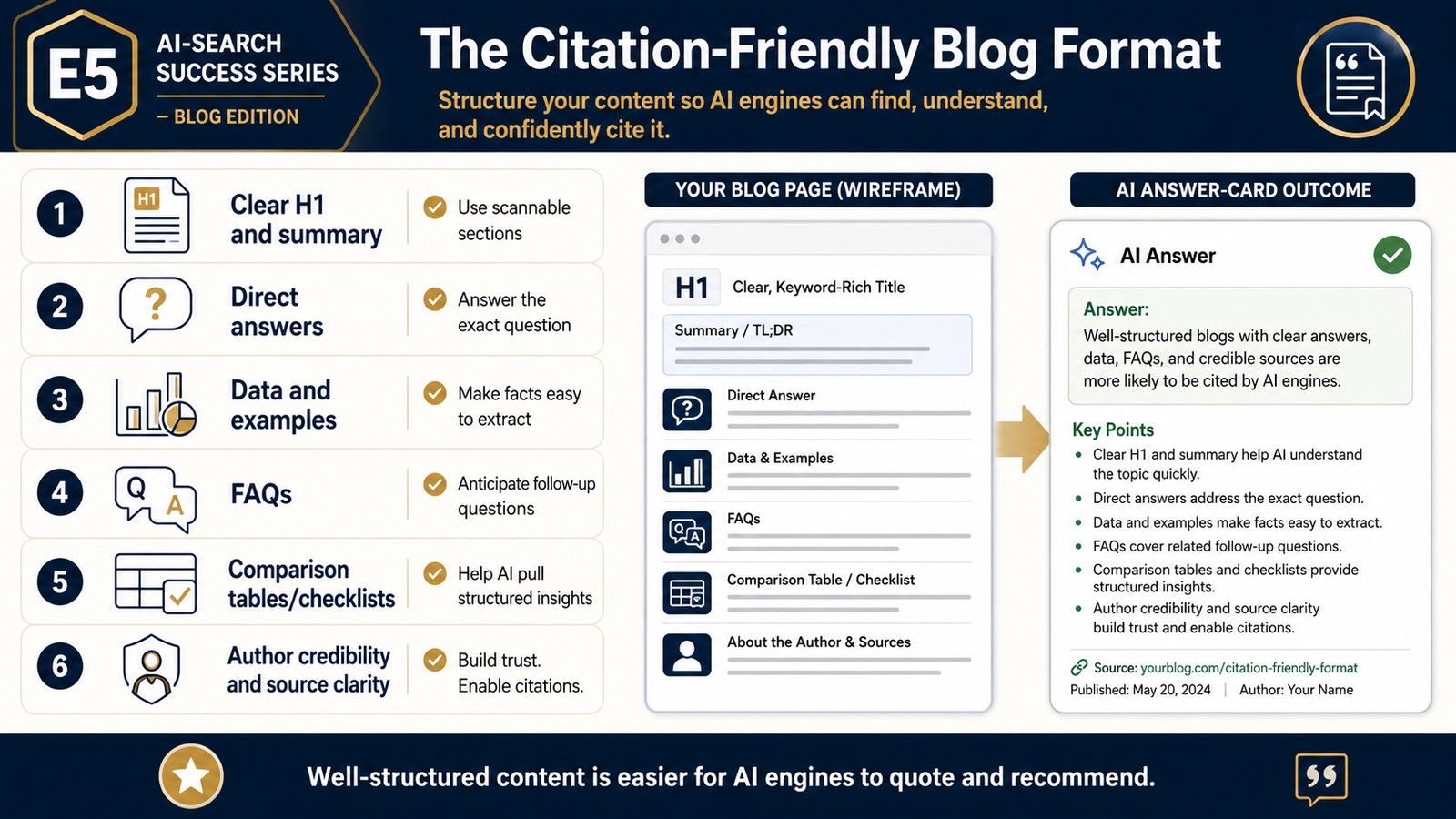
- Answer first, elaborate second. Open every section with the direct answer in one sentence, then explain. Engines lift the opening line; bury your answer in paragraph four and it's invisible.
- One idea per paragraph. Short, single-claim paragraphs are easy to extract cleanly. Walls of text force the engine to summarise — and your specific wording gets lost.
- Name it and date it. "S$2,950 psf in Q1 2026" is citable; "high prices recently" is not. Specific, dated, sourced figures are the most-quoted content type there is.
- Write headings as questions. Phrase H2s the way a buyer phrases a prompt — "How much is ABSD for a foreigner in 2026?" — so your section maps directly onto the question being asked.
- Use comparison tables. Tables are dense, structured and trivially extractable. A clean "Option A vs Option B" table often gets pulled straight into an answer.
- Define your terms. Spell out "ABSD (Additional Buyer's Stamp Duty)" the first time. Engines reward content that defines the entities it discusses — it makes you a clearer, safer source.
The one-sentence test
After writing each section, ask: if an engine pulled exactly one sentence from this, would it be true, specific, and useful on its own? If not, rewrite the opening line until it is. That single discipline does most of the work.
03 The structure engines love
Think inverted pyramid crossed with Q&A. Lead with the answer, support it with specifics, then add nuance — and wrap a genuine FAQ section around the real questions buyers ask. The chatbot-vetting reality is simple: an engine asked "what's ABSD for a foreign buyer?" will reach for the page that answers that exact question in its first line, under a heading that matches the prompt.
| Section | Job |
|---|---|
| 30-second summary box | The whole answer, extractable in one read |
| Question-style headings | Map your sections onto buyer prompts |
| Dated data + tables | Give the engine specific, citable facts |
| FAQ block | Capture the long-tail questions directly |
04 A reusable template for SG agents
For a district guide — your highest-value GEO asset — follow this skeleton:
- A 30-second summary stating the headline number (e.g. average psf, this quarter).
- "What's the property mix in [district]?" — answer first, then detail.
- "How much does it cost in 2026?" — a dated price table by property type.
- "Who buys here, and why?" — buyer segments with specifics.
- "What should a buyer watch out for?" — genuine, useful caveats.
- A 6–10 question FAQ covering the long-tail prompts.
Publish it on a domain you own, mark it up with schema, date it, and refresh the numbers each quarter. That single page can earn citations for years.
05 The mistakes that get you ignored
- Vague superlatives. "Best-in-class service" is unverifiable, so it's dropped. Replace with a fact.
- Undated claims. Without a date, an engine can't judge freshness and discounts the page.
- Walls of text. Long, multi-claim paragraphs are hard to extract cleanly.
- Keyword stuffing. Engines read meaning, not repetition; stuffing reads as low quality.
- No structure. No headings, no tables, no FAQ — nothing for the engine to grab.
Get the format right and your writing does double duty: it persuades the human and feeds the machine. Pair it with the foundations — what GEO is, how to get cited, and the schema guide — and every post you publish compounds your visibility.
Free AI visibility audit for your name
Want to see whether your current content is getting quoted by AI — or ignored? We'll test your pages against real buyer prompts and send a short video showing what an engine pulls from your site today, and what it skips.
Request a free AI audit →