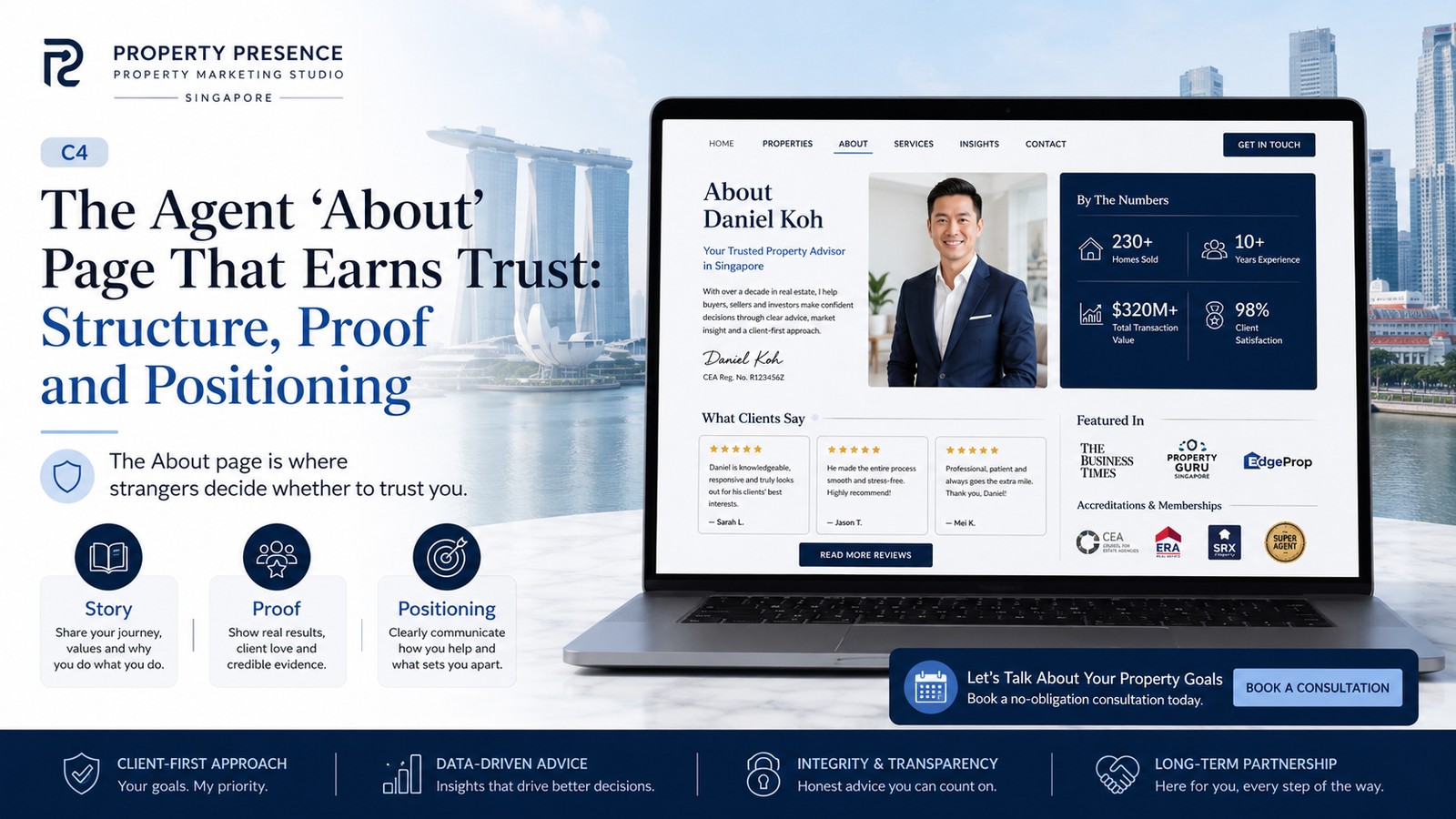
Your About page is the most-visited and most-undervalued page an agent has. A buyer who's interested goes there to answer one question: can I trust this person with one of the biggest transactions of my life? Most agent bios fail it — they're a list of awards and adjectives. A great About page does three things instead: it makes you specific, it makes you credible with proof, and it makes you relevant to this buyer. Here's the structure.
Read the average agent's "About" and you'll find the same paragraph everywhere: "passionate, dedicated, results-driven professional committed to exceptional service." It says nothing, because every one of Singapore's 37,000-plus agents could have written it. Meanwhile the buyer reading it is asking a sharp, specific question — am I safe with you? — and the generic bio answers it with noise. The About page is where trust is won or lost, and most agents lose it by being forgettable.
01 The one job of an About page
It isn't to impress — it's to reassure. A property transaction is high-stakes and emotional, and the buyer is quietly assessing risk. Your About page either lowers that perceived risk (specific experience, real proof, a sense of who you are) or leaves it high (vague claims, no evidence, a stock photo). Everything on the page should serve that one job: making the buyer feel safe choosing you.
The replace-the-adjective rule
For every adjective, substitute a fact. "Experienced" → "47 transactions across D9–D11 since 2022." "Trusted" → a named testimonial. "Results-driven" → an actual result. Adjectives are claims the reader discounts; facts are proof the reader believes. If you can't back an adjective with a fact, cut it.
02 The structure that converts
A high-trust About page generally follows this arc:
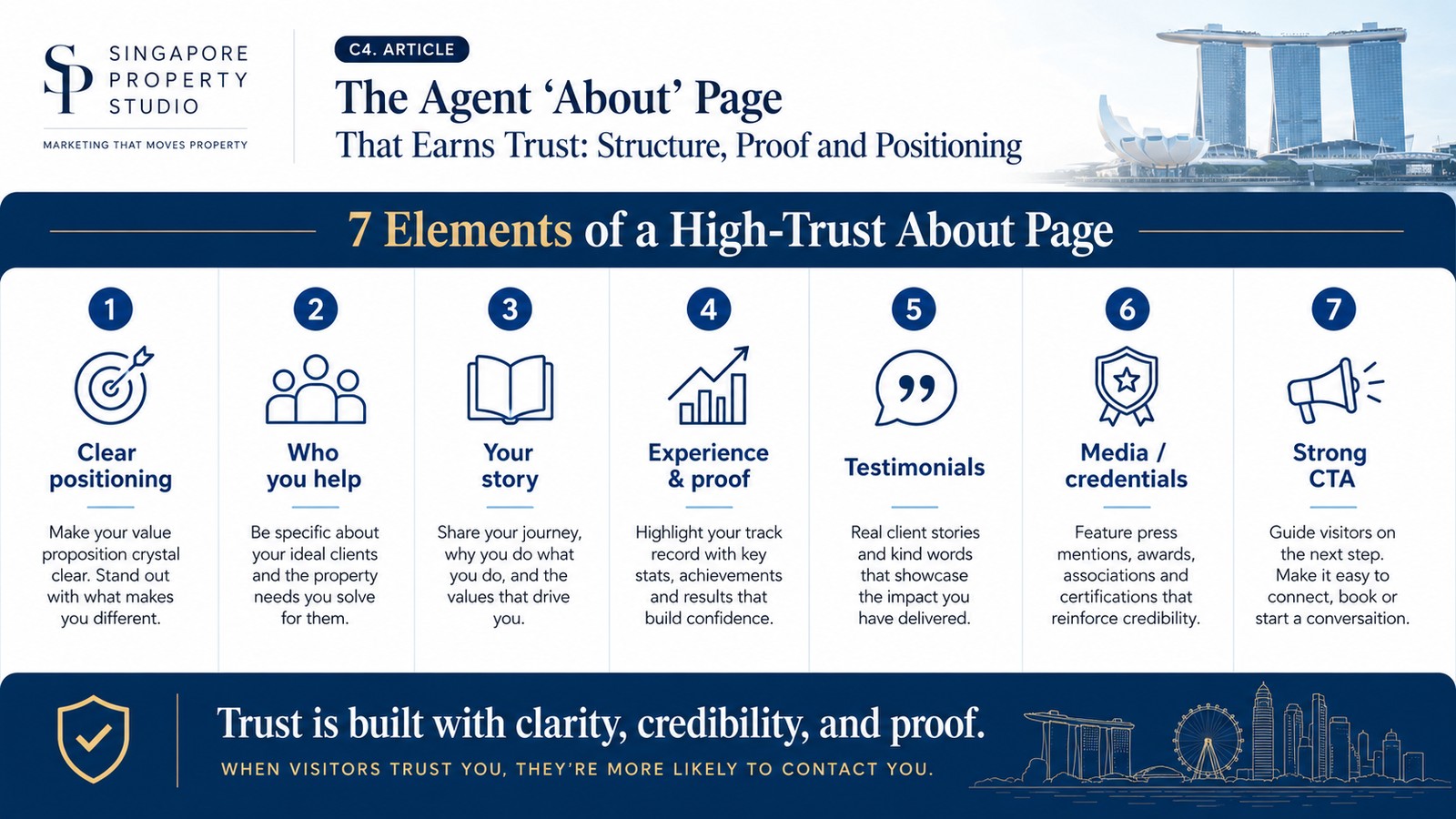
- A specific, human opening. Not "passionate professional" — a real, concrete line about who you help and how. Specificity signals confidence.
- Your focus. The districts, property types, or buyer segments you specialise in. A specialist is more trustworthy than a generalist who "does everything."
- Proof. Dated, concrete results — transaction counts, notable sales, years in your niche. This is the heart of the page.
- Social proof. Two or three genuine testimonials, ideally specific about outcomes.
- The human layer. A sentence or two that makes you a person, not a logo — why you do this, what clients can expect from working with you.
- A clear next step. Once trust is built, make contacting you effortless.
03 Specificity is the whole game
The single biggest upgrade to almost any agent bio is replacing the general with the specific. "I help clients buy and sell property in Singapore" is true of everyone. "I help foreign buyers navigate ABSD and secure freehold condos in Districts 9 and 10" tells a buyer in exactly that situation that you're their person. Specific positioning feels narrower — and converts wider, because the right buyer feels seen. This is the practical answer to looking identical to 37,000 other agents.
04 Proof beats persuasion
Buyers have read enough sales copy to discount it instinctively. What they can't discount is evidence: a real number, a dated result, a specific testimonial, your CEA registration, a press mention. Lead with proof and let it do the persuading. A page that shows "here's what I've actually done" outperforms one that tells "here's how great I am" every time — and the dated, verifiable proof doubles as a GEO signal that helps AI engines cite you.
05 Make it findable and machine-readable
Finally, a great About page should be easy for both buyers and engines to use. Put your name in the page title and headings so it helps you rank for your own name. Add Person and RealEstateAgent schema so search and AI engines can read your facts as structured data. The same page that reassures a human can, with a little structure, also make you citable by an AI — one page, working twice.
Round out the personal-brand cluster with ranking for your own name and Instagram vs a website.
Free personal-brand audit
Send us your current About page or bio and we'll send back a rewrite outline — where to swap adjectives for proof, sharpen your positioning, and structure it to build trust and rank for your name.
Request a free audit →