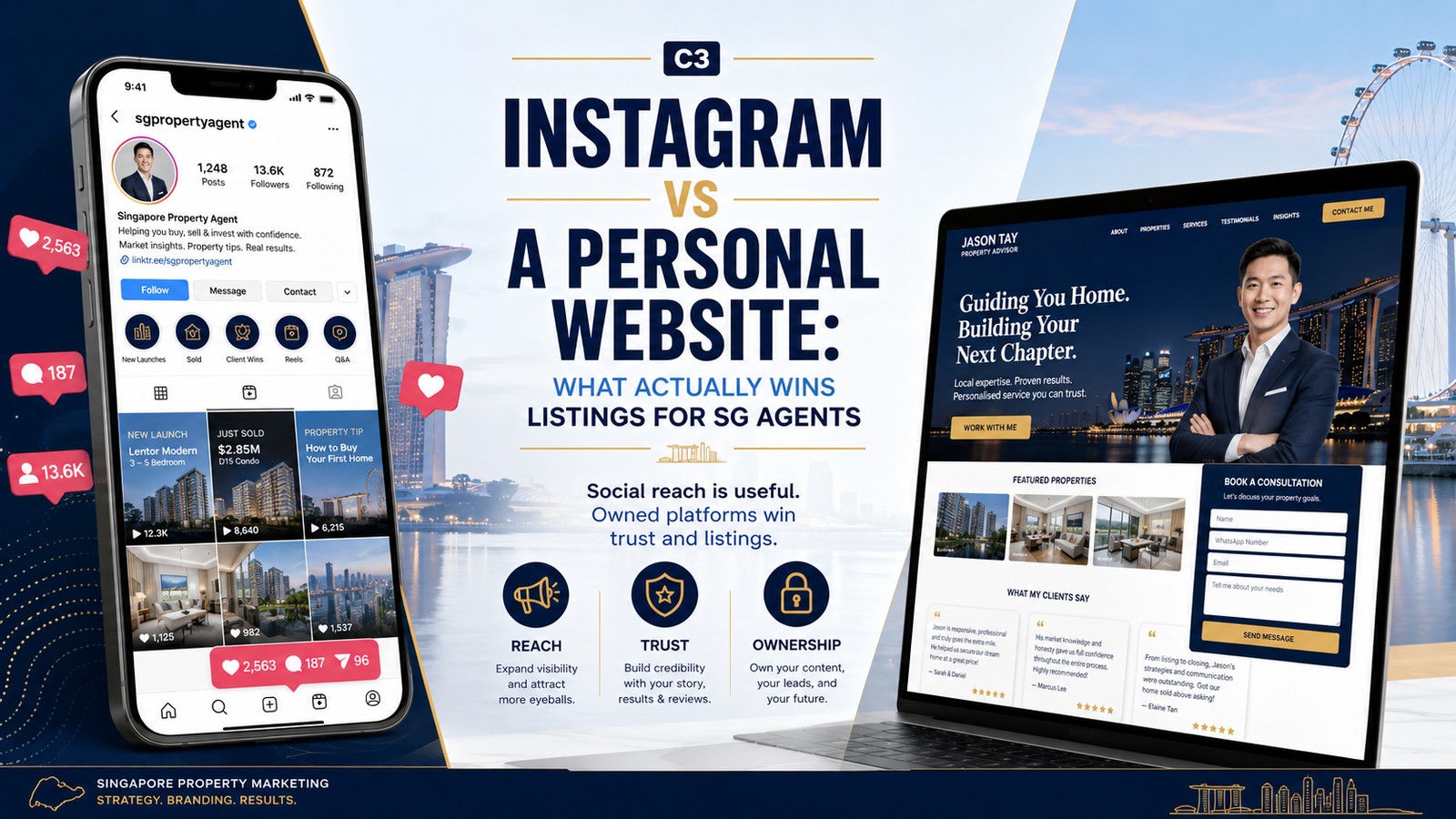
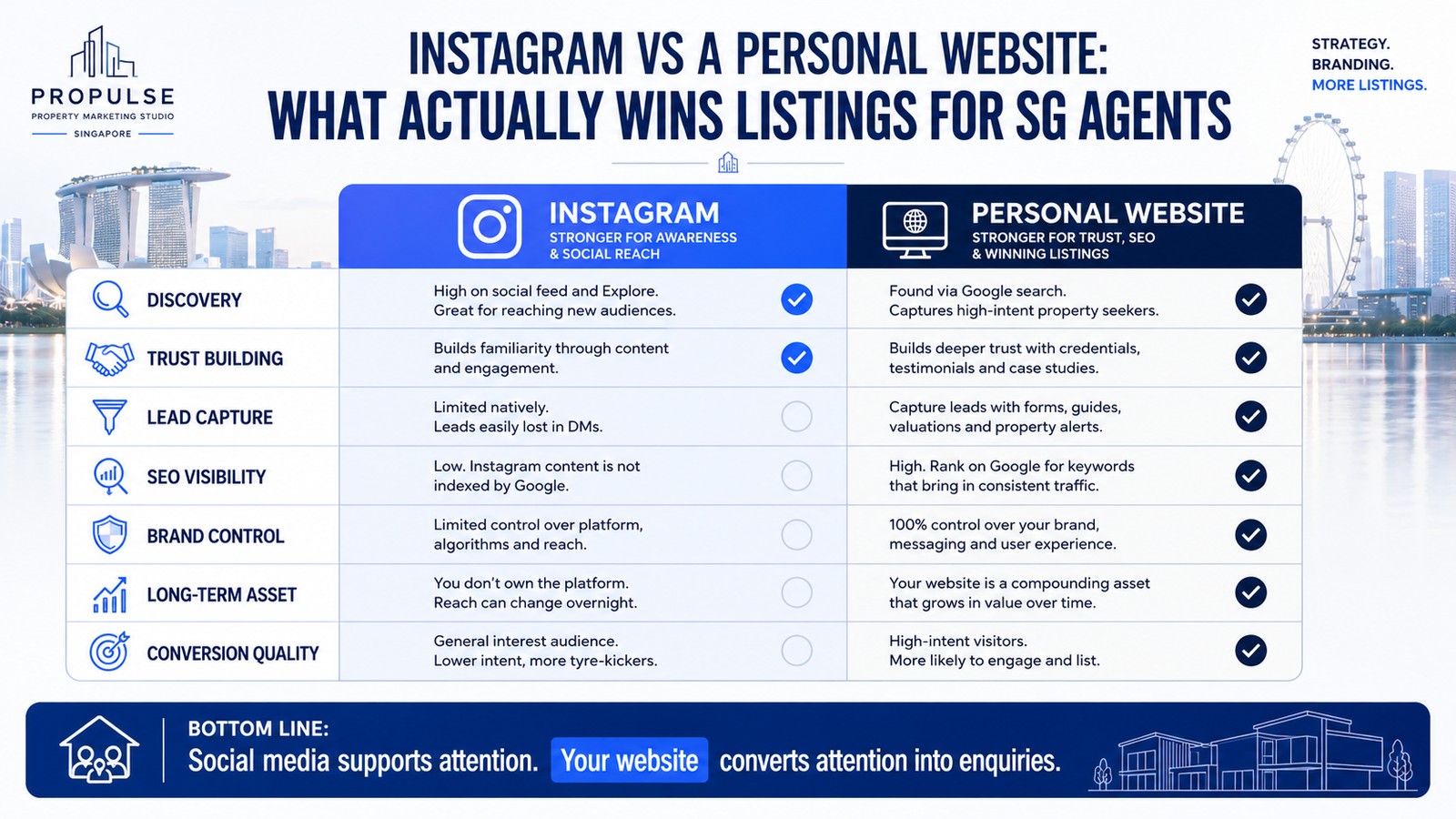
Instagram builds awareness; a website builds authority and ownership. The honest answer for most Singapore agents is that you need both — but if you only have Instagram, you're building your brand on rented land you don't control, where a buyer can't easily find your proof, and where the algorithm decides who sees you. The smartest move is to use social to attract attention and a website to convert it. Here's how the two compare and combine.
Plenty of Singapore agents have thousands of Instagram followers and no website — and quietly wonder why the followers don't turn into clients as often as they'd hoped. The reason isn't the content; it's the channel. Social media and a website do fundamentally different jobs, and treating one as a replacement for the other leaves money on the table. Let's settle which wins what.
01 What each one is actually for
Instagram and TikTok are discovery engines: they put you in front of people who weren't looking for you, build familiarity over time, and let personality shine. A website is a conversion and ownership engine: it's where an interested person goes to verify you, see your proof, and decide to make contact — on a platform you fully control.
| Instagram / TikTok | Website | |
|---|---|---|
| Job | Awareness & personality | Authority & conversion |
| You control | Content only | Everything |
| Found via | Algorithm decides | Google, your name, direct |
| Lifespan of a post | Hours to days | Years |
| Proof & trust | Hard to present clearly | Designed for it |
02 The risk of building on rented land
An Instagram following feels like an asset, but you don't own it. The platform controls your reach (the algorithm decides how many followers even see a post), it can change the rules overnight, and an account can be restricted or lost. Build your entire brand there and you're a tenant — your business depends on a landlord who can change the terms anytime. A website is land you own.
The follower-count trap
Followers are a vanity metric until they convert. Ten thousand followers who never enquire are worth less than a website that turns a hundred monthly visitors into five real conversations. The question isn't how many people follow you — it's how many become clients. Social earns attention; the website earns the business.
03 Where Instagram genuinely wins
This isn't an argument against social — it's an argument for using it correctly. Instagram and TikTok are excellent at the things a website can't do: showing your personality, building familiarity through repeated exposure, reaching people who'd never search for an agent, and humanising you so a cold viewer warms up. For top-of-funnel awareness, social is unmatched. The mistake is asking it to also be your proof, your conversion engine, and your owned asset.
04 How to combine them
The winning pattern is simple: attract on social, convert on the website.
- Use Instagram and TikTok to build awareness and personality — let people discover and warm to you.
- Point your bio link and calls to action to your website, where the interested ones go deeper.
- Let the website carry the proof, the full story, the trust signals and the contact path — the heavy lifting social can't do.
- The website also ranks for your name and feeds AI visibility, which a social account never will.
05 The verdict
Don't choose — sequence. If you have neither, the website usually comes first because it's the asset you own and the place that converts. If you already have a social following, add the website to capture and convert the attention you're already earning. Social without a website leaks; a website without social is quieter than it needs to be. Together, they compound: attention in, conversion and ownership out.
To make the website worth pointing your audience at, see ranking for your own name and the About page that converts.
Free personal-brand audit
Tell us your social handles and we'll send a short audit of how well your current setup converts attention into enquiries — and where adding (or improving) a website would close the gap.
Request a free audit →